Use the following required provisions language by the IRS on your State nonprofit articles of incorporation when incorporating your nonprofit organization or Amending your Certificate of Incorporation.
Not including the Purpose clause and Dissolution clause on your Nonprofit Articles of Incorporation will be the single most common reason that your form 1023 application will be rejected by the IRS. Use these provisions as is, do not change anything besides the names and the name of your State.
Please note that if you’re starting a Private Foundation, you have to include additional provisions specific to these types of entities which you can find on How to Start a Private Foundation page.
Purpose Clause Provision for Nonprofit 501c3 Organizations
[YOUR NONPROFIT ORGANIZATION NAME] is organized exclusively for charitable, religious, and educational purposes including, for such purposes, the making of distributions to organizations that qualify as exempt organizations under section 501(c)(3) of the Internal Revenue Code, or corresponding section of any future federal tax code. No part of the net earnings of [YOUR NONPROFIT ORGANIZATION NAME] shall inure to the benefit of, or be distributable to its members, trustees, officers, or other private persons, except that the corporation shall be authorized and empowered to pay reasonable compensation for services rendered and to make payments and distributions in furtherance of the purposes set forth in the purpose clause hereof.
Notwithstanding any other provision of this document, the corporation shall not carry on any other activities not permitted to be carried on (a) by any organization exempt from federal income tax under section 501 (c) (3) of the Internal Revenue Code, corresponding section of any future federal tax code, or (b) by an organization, contributions to which are deductible under section 170 (c) (2) of the Internal Revenue Code, or corresponding section of any future federal tax code.
[YOUR NONPROFIT ORGANIZATION NAME] is not organized and shall not be operated for the private gain of any person. The property of the corporation is irrevocably dedicated to its educational and charitable purposes. No part of the assets, receipts, or net earnings of the corporation shall inure to the benefit of, or be distributed to any individual. The corporation may, however, pay reasonable compensation for services rendered, and make other payments and distributions consistent with these Articles.
Dissolution Clause Provision for Nonprofit 501c3 Organizations
Upon termination or dissolution of the [YOUR NONPROFIT ORGANIZATION NAME], any assets lawfully available for distribution shall be distributed to one (1) or more qualifying organizations described in Section 501(c)(3) of the Internal Revenue Code of 1986 (or described in any corresponding provision of any successor statute) which organization or organizations have a charitable purpose which, at least generally, includes a purpose similar to the terminating or dissolving corporation.
The organization to receive the assets of the [YOUR NONPROFIT ORGANIZATION NAME] hereunder shall be selected by the discretion of a majority of the managing body of the [YOUR NONPROFIT ORGANIZATION NAME] and if its members cannot so agree, then the recipient organization shall be selected pursuant to a verified petition in equity filed in a court of proper jurisdiction against the [YOUR NONPROFIT ORGANIZATION NAME] by one (1) or more of its managing body which verified petition shall contain such statements as reasonably indicate the applicability of this section. The court upon a finding that this section is applicable shall select the qualifying organization or organizations to receive the assets to be distributed, giving preference if practicable to organizations located within the State of [YOUR STATE].
In the event that the court shall find that this section is applicable but that there is no qualifying organization known to it which has a charitable purpose, which, at least generally, includes a purpose similar to this corporation, then the court shall direct the distribution of its assets lawfully available for distribution to the Treasurer of the State of [YOUR STATE] to be added to the general fund.
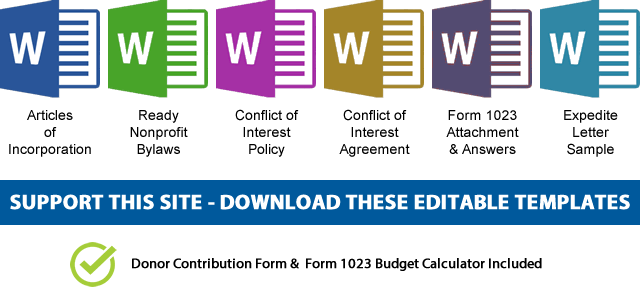 NOTE: If you’d like to receive the following organizing documents:
- Nonprofit Articles of Incorporation,
- Nonprofit Bylaws,
- Nonprofit Conflict of Interest Policy,
- Conflict of Interest Policy Acknowledgment,
- Form 1023 Attachment with all the answers,
- Form 1023 Expedite Letter template,
- and Donor Contribution Form
in Microsoft Word Document format, please consider making a donation and you’ll get to download them immediately. Not only they're worth well over $1000 in value, they will save you weeks of copy pasting and formatting as they are ready to go templates which only need changing names and addresses.