What is Nonprofit EIN?
 Nonprofit Employer Identification Number (EIN) is a Federal nine-digit tax ID number that IRS assigns to nonprofits, charities, organizations, and businesses in the following format: XX-XXXXXXX.
EIN is used to identify the tax accounts of employers and certain others who have no employees.
Nonprofit organizations and charities are required to have their EIN prior to starting a nonprofit organization and filing for tax exemption. It is also a required document from all banks to open a nonprofit bank account.
The IRS uses the EIN tax ID number to identify taxpayers that are required to file various business tax returns.
Do nonprofits need an EIN?
In the case of charities, tax-exempt nonprofit organizations are required to file Information Return form 990, most commonly known as the Form 990 at the end of each year and the EIN is used for this purpose as well.
EIN is used by employers period, no matter if your business is a sole proprietor, corporation, partnership, nonprofit organization, trust, estates of decedents, or even a government agency. Certain individuals, and other business entities may apply for Employer Identification as well. You should use your Nonprofit EIN on all the forms and paperwork that you send to the IRS.
All your paperwork and organizing documents such as bylaws and conflict of interest policy from now on should be adorned with your brand new EIN. Your organization can be found with this number from now on through searches, and any and all information regarding your nonprofit charity can be accessed through this number. Unlike the Social Security Number, you don’t have to hide it as no one seems to have an interest in abusing it.
How and where to get an EIN?
The second step in starting a nonprofit organization after Nonprofit Incorporation is to apply for EIN from the IRS. Whether you are going to have employees in your nonprofit organization or not, you need to apply for the Employer Identification Number. The EIN is like a social security number for your non-profit, as the IRS will identify your organization with this number from now on. The good news is that it’s a super simple process, FREE, and has one of the quickest turnaround times. You can apply for the Nonprofit EIN from the IRS here.
Do NOT pay for your nonprofit EIN
EIN for nonprofit organizations is free, and it only takes a few minutes to get. Don’t fall for the so called one-stop Incorporation Service sites that want to charge you for their service. Just use the link to the IRS above and apply for your EIN yourself and save a few hundred dollars.
The information you’ll need are the business name, Mission of the organization and personal information. The application is very simple and you should have your EIN receipt in PDF format at the end of the process. Keep this PDF receipt, it’s required for sending along with your form 1023 application later to the IRS, and for filing your Information Return 990.
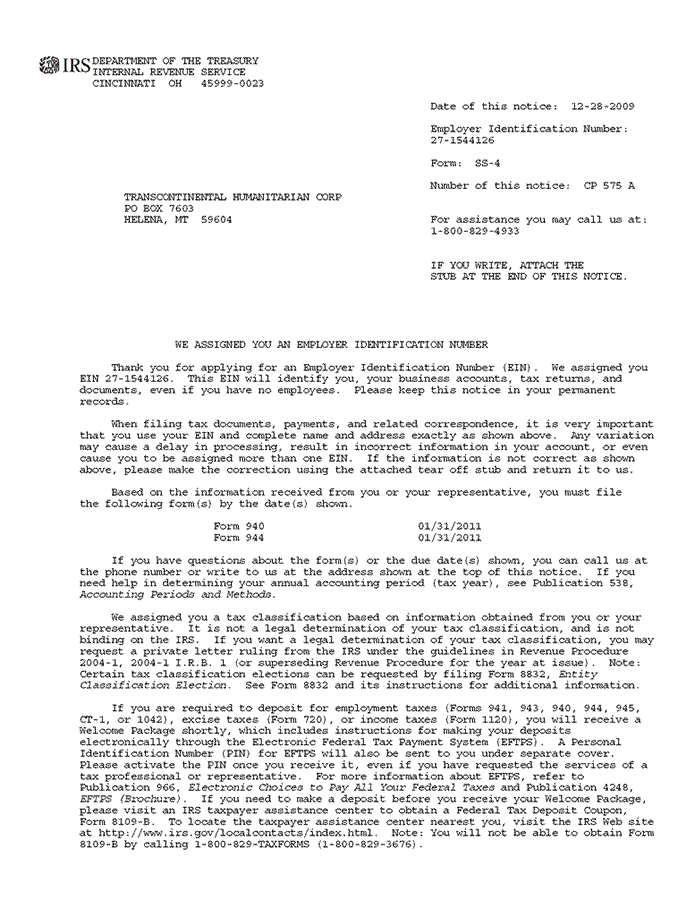
You will receive a letter and an instant email with a PDF attachment from the IRS informing you of your EIN which will look like this one:
So you got your Nonprofit EIN, now what?
If you haven’t read the guide on how to start a nonprofit 501c3 organization yet, you should read it first. Once you have the Employer Identification Number, you now have all the necessary information and documents to start your form 1023 application. Let’s recap; by now you should have your Articles of Incorporation, Bylaws, Conflict of Interest Policy, and EIN. The next step is to start on the Part I of the application for tax exemption. Click the button below to start your exemption journey or return to the previous page.
(Next Step) Instructions For IRS Form 1023 Part I – Identification Of Applicant
(Previous Step) Create your Nonprofit Conflict Of Interest Policy with Sample
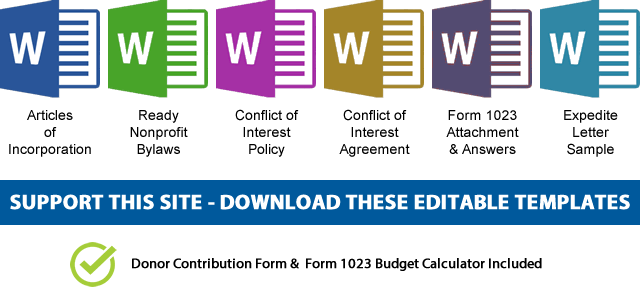 NOTE: If you’d like to receive the following organizing documents:
- Nonprofit Articles of Incorporation,
- Nonprofit Bylaws,
- Nonprofit Conflict of Interest Policy,
- Conflict of Interest Policy Acknowledgment,
- Form 1023 Attachment with all the answers,
- Form 1023 Expedite Letter template,
- and Donor Contribution Form
in Microsoft Word Document format, please consider making a donation and you’ll get to download them immediately. Not only they're worth well over $1000 in value, they will save you weeks of copy pasting and formatting as they are ready to go templates which only need changing names and addresses.