 Nonprofit Board Meeting Minutes shouldn’t be complicated. Stay away from ungodly complicated Robert’s Rules of Order and such nonsense. All you need is a simple board minute sample to record your board meeting agenda, attendance and decisions.
If you’ve drafted your nonprofit bylaws the correct way, there should be no confusion in the roll and duties of each director of the board of directors and you know who will call the meeting, who’ll record the minutes, and how the board meeting should proceed.
Here’s a sample / template board meeting minutes I put together for you which will cover all your board meetings needs, regardless of size of the organization.
Minutes of the Board Meeting of [Nonprofit Organization Name]
Date: [Date of the Meeting] Time: [Start Time of the Meeting]
Location: [Location of the Meeting]
Attendance: [Insert the names of the board members who attended the meeting. If any board members were absent, note their names.]
Call to Order: The meeting was called to order at [Insert Start Time of the Meeting] by [Insert Name of the Board Chair].
Approval of the Agenda: The agenda for the meeting was reviewed and approved with no changes.
Approval of Previous Minutes: The minutes from the previous board meeting, held on [Insert Date of Previous Meeting], were reviewed and approved with no changes.
Reports: [Insert the names of any board members or staff members who are scheduled to give reports or updates. For example:]
- President’s Report: [Insert summary of the President’s report]
- Treasurer’s Report: [Insert summary of the Treasurer’s report]
- Committee Reports: [Insert summary of any committee reports]
Old Business: [Insert any old business that was discussed during the meeting. For example:]
- Discussion of progress on the strategic plan
- Review of progress on fundraising goals
New Business: [Insert any new business that was discussed during the meeting. For example:]
- Discussion of potential new partnership opportunities
- Approval of budget for upcoming fiscal year
Public Comment: If your nonprofit allows for public comment during board meetings, you can include a section for this. [Insert names of any members of the public who spoke during the public comment period. Summarize their comments.]
Executive Session: If the board went into executive session during the meeting, you can summarize what was discussed, without going into too much detail.
For example:
Executive Session: The board went into executive session at [Insert Time of Executive Session] to discuss [Insert Topic of Executive Session]. No action was taken during the executive session.
Motions and Votes: If any motions were made and voted on during the meeting, you can include a summary of the motion and the outcome of the vote.
For example:
Motions and Votes:
- Motion made by [Insert Name of Board Member] to approve the budget for the upcoming fiscal year. Seconded by [Insert Name of Board Member]. Vote: [Insert Number of Votes in Favor], [Insert Number of Votes Against], [Insert Number of Abstentions]. Motion passed.
Action Items: If any action items were assigned during the meeting, you can list them here, along with the person responsible for completing each item and the deadline for completion.
For example:
Action Items:
- [Insert Name of Board Member] to follow up with potential new partner regarding collaboration opportunities. Deadline: [Insert Deadline Date].
- [Insert Name of Board Member] to provide updated progress report on strategic plan. Deadline: [Insert Deadline Date].
Adjournment: There being no further business to come before the board, the meeting was adjourned at [Insert End Time of the Meeting] by [Insert Name of the Board Chair].
Respectfully submitted,
[Insert Name of the Secretary and Board Meeting Date]
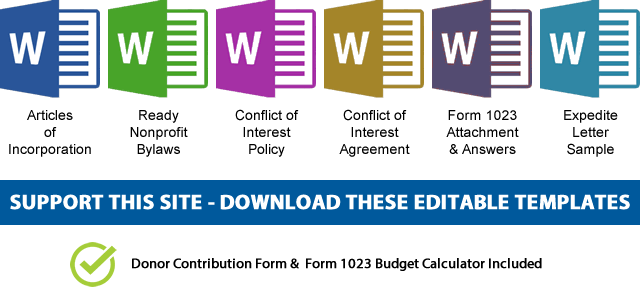 NOTE: If you’d like to receive the following organizing documents:
- Nonprofit Articles of Incorporation,
- Nonprofit Bylaws,
- Nonprofit Conflict of Interest Policy,
- Conflict of Interest Policy Acknowledgment,
- Form 1023 Attachment with all the answers,
- Form 1023 Expedite Letter template,
- and Donor Contribution Form
in Microsoft Word Document format, please consider making a donation and you’ll get to download them immediately. Not only they're worth well over $1000 in value, they will save you weeks of copy pasting and formatting as they are ready to go templates which only need changing names and addresses.