What is the purpose of nonprofit Conflict of Interest Policy?
The sole purpose of a Nonprofit Conflict of Interest Policy is to protect the 501c3 tax exempt nonprofits from conducting inappropriate business or make arrangements with its officers, directors, trustees, persons of interest, or anyone who would benefit directly or indirectly from public funds of the nonprofit organization. Failure to do so will result in loss of tax exemption status.
A good 501c3 Nonprofit Conflict of Interest Policy should have the following sections (Sample Policy is at the bottom of this page). Here are the major articles and main steps on how to write an effective Conflict of Interest Policy:
- Conflict of Interest Purposes
- Conflict of Interest Definitions
- Conflict of Interest Procedures
- Conflict of Interest Records of proceedings
- Conflict of Interest Compensation
- Conflict of Interest Annual statements
- Conflict of Interest Periodic reviews
- Conflict of Interest Use of outside experts
- Certificate of adoption of Conflict of Interest Policy
As I’ve mentioned countless times through these instruction pages, a non-profit organization is formed to serve the public, not to benefit select individuals. If you allow your 501c3 tax-exempt nonprofit organization to do so, your exempt status will be revoked, plain and simple. The nonprofit conflict of interest policy is a strategy that every nonprofit organization should adopt as a mean to establish procedures that will offer protection against charges of impropriety involving officers, directors, or trustees.
Is a nonprofit Conflict of Interest Policy specific to each State?
No. A conflict of Interest policy is not required by most States, and they don’t have specific requirements on this document. It is however required by the IRS. So in short, you don’t need a conflict of interest policy at the the time of the incorporation, but you absolutely need it for applying for tax exemption using the Form 1023.
What is Conflict of Interest in nonprofits exactly?
In a non-profit organization, conflicts of interest occur where individuals’ obligation to further the organization’s charitable purposes is at odds with their own financial interests. For example, conflict of interest happens where an officer, director, board member, or trustee votes on a contract between the organization and a business that is owned by the officer, director or board member.
 Conflicts of interest frequently arise when setting compensation or benefits for officers, directors, or members. A conflict of interest policy is intended to help ensure that when actual or potential conflicts of interest arise, the nonprofit organization has a process in place under which the affected individual will advise the governing body about all the relevant facts concerning the situation. A conflict of interest policy is also intended to establish procedures under which individuals who have a conflict of interest will be excused from voting on such matters at board meetings.
Apart from any appearance of impropriety, 501c3 exempt organizations will lose their tax-exempt status unless they operate in a manner consistent with their legal charitable purposes. Serving private interests more than insubstantially is inconsistent with accomplishing charitable purposes.
The following is a nonprofit Conflict of Interest Policy template that you can use as is for applying for 501c3 exemption status. This sample is complete, proven and satisfies the requirements of the IRS for conflict of interest. Read the template carefully, and draft your Conflict of Interest Policy based on sample information given here.
Nonprofit Conflict of Interest Policy, Purpose
The first article of the nonprofit conflict of interest policy in this template concerns itself with the purpose of this policy, explanation of what conflict of interest is, and a general overview of the conflict of interest and how to avoid it, and most importantly, how to safeguard the exempt status of the nonprofits.
NONPROFIT CONFLICT OF INTEREST POLICY
ARTICLE I, PURPOSES
It is important for [YOUR NONPROFIT ORGANIZATION NAME] directors, officers, and staff to be aware that both real and apparent conflicts of interest or dualities of interest sometimes occur in the course of conducting the affairs of the corporation and that the appearance of conflict can be troublesome even if there is in fact no conflict whatsoever.
Conflicts occur because the many persons associated with the corporation should be expected to have, and do in fact generally have multiple interests and affiliations and various positions of responsibility within the community. In these situations a person will sometimes owe identical duties of loyalty to two or more corporations. The purpose of the conflict of interest policy is to protect the corporation’s tax-exempt interest when it is contemplating entering into a transaction or arrangement that might benefit the private interest of an officer or director of the corporation or might result in a possible excess benefit transaction.
Conflicts are undesirable because they potentially or eventually place the interests of others ahead of the corporation’s obligations to its charitable purposes and to the public interest. Conflicts are also undesirable because they often reflect adversely upon the person involved and upon the institutions with which they are affiliated, regardless of the actual facts or motivations of the parties. However, the long-range best interests of the corporation do not require the termination of all association with persons who may have real or apparent conflicts that are harmless to all individuals or entities involved.
Each member of the board of directors and the staff of the corporation has a duty of loyalty to the corporation. The duty of loyalty generally requires a director or staff member to prefer the interests of the corporation over the director’s/staff’s interest or the interests of others. In addition, directors and staff of the corporation shall avoid acts of self-dealing which may adversely affect the tax-exempt status of the corporation or cause there to arise any sanction or penalty by a governmental authority.
The policy is intended to supplement but not replace any applicable state and federal laws governing conflict of interest applicable to nonprofit and charitable organizations.
Nonprofit Conflict of Interest Policy, Definitions
Article II of the conflict of interest policy defines specifically the financial interest whether direct or indirect of the officers, directors, or trustees in a nonprofit organization. It basically discourages and prohibits gifts, favors, loans, and transaction arrangements between directors, officers, or employees of the organization.
NONPROFIT CONFLICT OF INTEREST POLICY
ARTICLE II, DEFINITIONS
Interested Person
Any director, principal officer, or member of a committee with governing board delegated powers, who has a direct or indirect financial interest, as defined below, is an interested person.
Financial Interest
A person has a financial interest if the person has, directly or indirectly, thorough business, investment, or family:
- An ownership or investment interest in any entity with which the corporation has a transaction or arrangement,
- A compensation arrangement with the corporation or with any entity or individual with which the corporation has a transaction or arrangement, or
- A potential ownership or investment interest in, or compensation arrangement with, any entity or individual with which the corporation is negotiating a transaction or arrangement.
Compensation includes direct and indirect remuneration as well as gifts or favors that are not insubstantial. A financial interest is not necessarily a conflict of interest. Under Article III, Section 2, a person who has a financial interest may have a conflict of interest only if the appropriate governing board or committee decides that a conflict of interest exists.
Nonprofit Conflict of Interest Policy, Procedures
This is the longest section of the policy and it sets the rules and procedures for disclosing the potential conflicts of interest and how to address them. It also sets measures in place for violation of the conflict of interest policy.
NONPROFIT CONFLICT OF INTEREST POLICY
ARTICLE III, PROCEDURES
Duty to Disclose
In connection with any actual or possible conflict of interest, an interested person must disclose the existence of the financial interest and be given the opportunity to disclose all material facts to the directors and members of committees with governing board delegated powers considering the proposed transaction or arrangement
3.2 Determining Whether a Conflict of Interest Exists
After disclosure of the financial interest and all material facts, and after any discussion with the interested person, he/she shall leave the governing board or committee meeting while the determination of a conflict of interest is discussed and voted upon. The remaining board or committee members shall decide if a conflict of interest exists.
Procedures for Addressing the Conflict of Interest
- An interested person may make a presentation at the governing board or committee meeting, but after the presentation, he/she shall leave the meeting during the discussion of, and the vote on, the transaction or arrangement involving the possible conflict of interest.
- The chairperson of the governing board or committee shall, if appropriate, appoint a disinterested person or committee to investigate alternatives to the proposed transaction or arrangement.
- After exercising due diligence, the governing board or committee shall determine whether the corporation can obtain with reasonable efforts a more advantageous transaction or arrangement from a person or entity that would not give rise to a conflict of interest.
- If a more advantageous transaction or arrangement is not reasonably possible under circumstances not producing a conflict of interest, the governing board or committee shall determine by a majority vote of the disinterested directors whether the transaction or arrangement is in the corporation’s best interest, for its own benefit, and whether it is fair and reasonable. In conformity with the above determination it shall make its decision as to whether to enter into the transaction or arrangement.
Violations of the Conflicts of Interest Policy
- If the governing board or committee has reasonable cause to believe a member has failed to disclose actual or possible conflicts of interest, it shall inform the member of the basis for such belief and afford the member an opportunity to explain the alleged failure to disclose.
- If, after hearing the member’s response and after making further investigation as warranted by the circumstances, the governing board or committee determines the member has failed to disclose an actual or possible conflict of interest, it shall take appropriate disciplinary and corrective action.
Nonprofit Conflict of Interest Policy, Records of Proceedings
This section of the template explains the records of proceedings when a director or officer discloses a possible conflict of interest and actions that are taken by the boards to safeguard against it. This is why it’s imperative to keep board minutes at all board meetings, specially if the agenda includes possible conflict of interest issues between board members.
NONPROFIT CONFLICT OF INTEREST POLICY
ARTICLE IV, RECORDS OF PROCEEDINGS
Board Minutes
The minutes of the governing board and all committees with board delegated powers shall contain:
- The names of the persons who disclosed or otherwise were found to have a financial interest in connection with an actual or possible conflict of interest, the nature of the financial interest, any action taken to determine whether a conflict of interest was present, and the governing board’s or committee’s decision as to whether a conflict of interest in fact existed.
- The names of the persons who were present for discussions and votes relating to the transaction or arrangement, the content of the discussion, including any alternatives to the proposed transaction or arrangement, and a record of any votes taken in connection with the proceedings.
Nonprofit Conflict of Interest Policy, Compensation
This section of the conflict of interest policy sample prohibits voting members of the board from approving compensations when they clearly have a conflict of interest. For example, a board of directors that is comprised of two family members, a husband and wife will fall in this scenario.
NONPROFIT CONFLICT OF INTEREST POLICY
ARTICLE V, COMPENSATION
5.1 A voting member of the governing board who receives compensation, directly or indirectly, from the corporation for services is precluded from voting on matters pertaining to that member’s compensation.
5.2 A voting member of any committee whose jurisdiction includes compensation matters and who receives compensation, directly or indirectly, from the corporation for services is precluded from voting on matters pertaining to that member’s compensation.
5.3. No voting member of the governing board or any committee whose jurisdiction includes compensation matters and who receives compensation, directly or indirectly, from the corporation, either individually or collectively, is prohibited from providing information to any committee regarding compensation.
Nonprofit Conflict of Interest Policy, Annual Statements
It is important for tax-exempt nonprofits to have staff and board members sign an agreement statement which affirms that such persons have received the conflict of interest policy, understand the policy, and agree to comply with it. This record should be kept by the organization, but it is not necessary to be sent along with your application for tax exemption to the IRS.
NONPROFIT CONFLICT OF INTEREST POLICY
ARTICLE VI, ANNUAL STATEMENTS
Each director, principal officer and member of a committee with governing board delegated powers shall annually sign a statement which affirms such person:
- Has received a copy of the conflicts of interest policy,
- Has read and understands the policy,
- Has agreed to comply with the policy, and
- Understands that the corporation is charitable and in order to maintain its federal tax exemption it must engage primarily in activities which accomplish one or more of its tax-exempt purposes.
Nonprofit Conflict of Interest Policy, Periodic Reviews
Periodic reviews should be taken by the board to ensure legality of activities of the organization, and most importantly to prevent or curtail harmful activities to the exempt purpose of the organization.
NONPROFIT CONFLICT OF INTEREST POLICY
ARTICLE VII, PERIODIC REVIEWS
To ensure the corporation operates in a manner consistent with charitable purposes and does not engage in activities that could jeopardize its tax-exempt status, periodic reviews shall be conducted. The periodic reviews shall, at a minimum, include the following subjects:
- Whether compensation arrangements and benefits are reasonable, based on competent survey information and the result of arm’s length bargaining.
- Whether partnerships, joint ventures, and arrangements with management corporations conform to the corporation’s written policies, are properly recorded, reflect reasonable investment or payments for goods and services, further charitable purposes and do not result in inurement, impermissible private benefit or in an excess benefit transaction.
Nonprofit Conflict of Interest Policy, Use of Outside Experts
This article is more for larger nonprofit organizations as the use of outside experts is costly, however, you should still include this template part in your policy as you never know how big your organization is going to get.
NONPROFIT CONFLICT OF INTEREST POLICY
ARTICLE VIII, USE OF OUTSIDE EXPERTS
When conducting the periodic reviews as provided for in Article VII, the corporation may, but need not, use outside advisers. If outside experts are used, their use shall not relieve the governing board of its responsibility for ensuring periodic reviews are conducted.
CERTIFICATE OF ADOPTION OF CONFLICT OF INTEREST POLICY
I do hereby certify that the above stated Conflict of Interest Policy and Agreement for [YOUR ORGANIZATION NAME] were approved and adopted by the board of directors on XX, XX, 20XX and constitute a complete copy of the Conflict of Interest Policy of the corporation.
_____________________________
[Secretary’s Name], Secretary
Date: ________________
Conclusion
A 501c3 nonprofit Conflict of Interest Policy is not just another documents to have because the IRS requires it; it is one of the most important and useful documents that your organization possesses. I have given you my years of knowledge and experience dealing with nonprofit organizations, spent countless hours explaining and organizing these templates and samples, and have combined these tips and tricks here for you so you can form a nonprofit with a little less pain. Please take the time to understand these instructions and don’t just copy paste.
The next step in starting a nonprofit organization is to apply for your Employer Identification Number (EIN). Click on the button below to get started on your EIN, learn what the EIN is, how to get one, and how much it costs.
(Next Step) What Is An EIN And How To Get One For Your Nonprofit
(Previous Step) Create your Nonprofit Bylaws With Sample
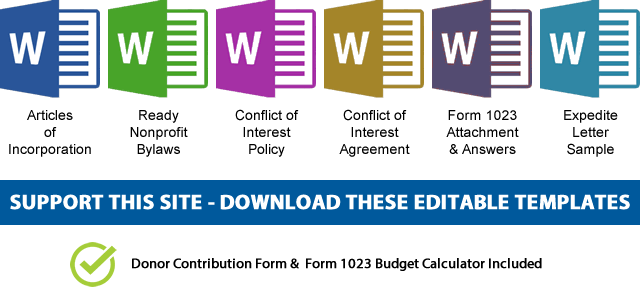 NOTE: If you’d like to receive the following organizing documents:
- Nonprofit Articles of Incorporation,
- Nonprofit Bylaws,
- Nonprofit Conflict of Interest Policy,
- Conflict of Interest Policy Acknowledgment,
- Form 1023 Attachment with all the answers,
- Form 1023 Expedite Letter template,
- and Donor Contribution Form
in Microsoft Word Document format, please consider making a donation and you’ll get to download them immediately. Not only they're worth well over $1000 in value, they will save you weeks of copy pasting and formatting as they are ready to go templates which only need changing names and addresses.